Case Study

Launching a new TV product into a crowded market.
Competitive pressure, fixed constraints, and cross-market complexity meant the product needed validating before launch.
A user research and UX case study focused on validating a new TV product in a competitive, constrained environment.
Client
Vodafone
Sector
Media
Role
UX Lead
Services
User Research, Testing Strategy, Hardware Testing, Benchmarking
Project overview
Launching a TV platform into a saturated market.
Vodafone was preparing to launch its TV glossaryPlatformA platform is a system or environment that enables users, services, or applications to interact, build, or operate.Open glossary term into the UK, one of the most competitive and mature media markets.
This wasn’t a new concept. Players like Sky and Virgin were already deeply embedded, with strong customer loyalty and established viewing habits.
At the same time, Vodafone operated across multiple regions, including Spain, each with different expectations, glossaryBehaviourBehaviour refers to how users interact with a system, including actions, patterns, and responses.Open glossary term and regulatory glossaryConstraintsConstraints are limitations or restrictions that impact how a product or solution can be designed or built.Open glossary term.
I was brought in to glossaryLeadA lead is a potential customer who has shown interest in a product or service, typically by providing contact information or engaging with content.Open glossary term the testing glossaryStrategyStrategy is a high-level plan that defines long-term goals and the approach to achieving them.Open glossary term, ensuring the product was grounded in real glossaryUser BehaviourUser behaviour refers to how users interact with a product, including actions, patterns, and decision-making processes.Open glossary term and ready for launch.
This wasn’t about validating a finished product. It was about shaping it before it reached the market.
What was happening
What worked elsewhere wouldn’t work here.
Vodafone had successfully launched TV products in other markets, but the UK presented a very different challenge.
User expectations were higher. On-demand content, seamless glossaryIntegrationIntegration is the process of connecting different systems, tools, or services to work together.Open glossary term and personalisation were expected as standard.
In contrast, Spanish audiences leaned more towards traditional broadcast viewing, with different content preferences and glossaryBehaviourBehaviour refers to how users interact with a system, including actions, patterns, and responses.Open glossary term.
On top of that, strict digital rights management (DRM) rules dictated how content could be delivered, stored and even navigated.
This created tension. The product needed to feel seamless, but the glossaryConstraintsConstraints are limitations or restrictions that impact how a product or solution can be designed or built.Open glossary term behind it made that difficult.
A direct rollout from one market to another would have failed.
Approach
Test across markets. Understand behaviour. Work within constraints.
The focus was on building a clear understanding of both glossaryUser BehaviourUser behaviour refers to how users interact with a product, including actions, patterns, and decision-making processes.Open glossary term and technical limitations before launch.
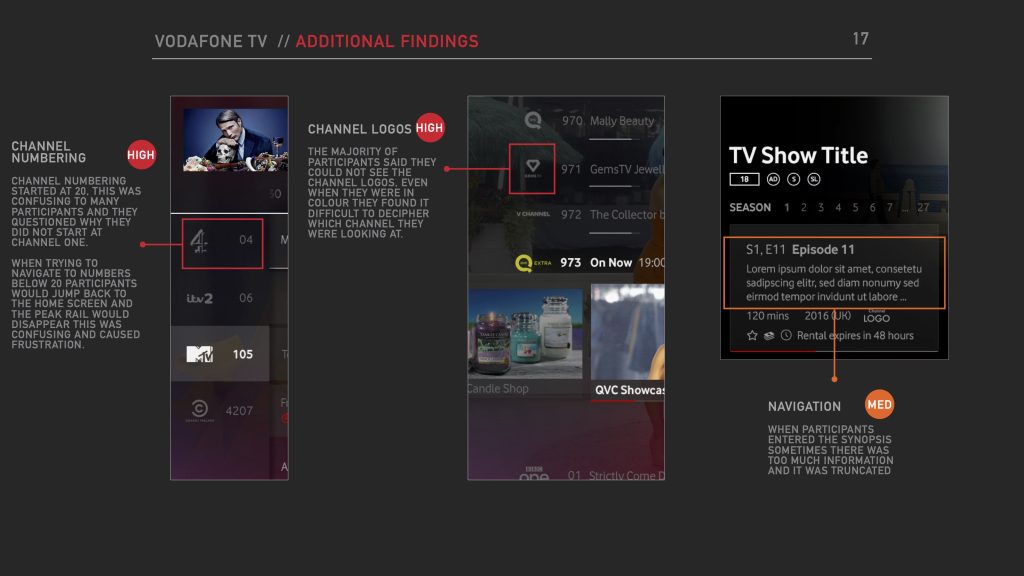
User testing was carried out across the UK and Spain, observing how people interacted with the glossaryPlatformA platform is a system or environment that enables users, services, or applications to interact, build, or operate.Open glossary term, how they discovered content, and where glossaryFrictionFriction refers to anything that slows users down or makes it harder for them to complete a task. It can be caused by poor design, unnecessary steps, unclear messaging, or technical issues.Open glossary term appeared.
This highlighted key differences in glossaryBehaviourBehaviour refers to how users interact with a system, including actions, patterns, and responses.Open glossary term, expectations and priorities between markets.
Hardware testing was also critical. The remote control is a core part of the experience, and early testing exposed issues with glossaryResponsivenessHow well a design adapts to different screen sizes.Open glossary term, glossaryLatencyLatency is the time delay between a user action and the system response.Open glossary term and glossaryUsabilityUsability is how easy and efficient it is for users to complete tasks within a product. It focuses on clarity, simplicity, and reducing effort so users can achieve their goals without confusion or friction.Open glossary term. These were fed back directly to suppliers, improving the product before release.
Competitor analysis provided further glossaryContextThe surrounding conditions that shape behaviour and decisions.Open glossary term, benchmarking Vodafone against established players and identifying where it needed to meet or exceed expectations.
Alongside this, plans were developed for an internal testing lab, ensuring that testing would continue beyond launch rather than stopping at it.
Key decisions
Design within constraints, not against them.
A key decision was to accept that not all glossaryConstraintsConstraints are limitations or restrictions that impact how a product or solution can be designed or built.Open glossary term could be removed.
DRM restrictions, licensing agreements and broadcaster requirements limited what could be built and how it could behave.
Rather than fighting those glossaryConstraintsConstraints are limitations or restrictions that impact how a product or solution can be designed or built.Open glossary term, the focus shifted to working within them. Designing experiences that still felt coherent, even when the underlying glossarySystemA system is a collection of interconnected components that work together to achieve a specific function or outcome.Open glossary term were fragmented.
Another important decision was to treat each market independently. What worked in Spain wouldn’t necessarily work in the UK, and forcing a single approach would have created glossaryFrictionFriction refers to anything that slows users down or makes it harder for them to complete a task. It can be caused by poor design, unnecessary steps, unclear messaging, or technical issues.Open glossary term.
Testing became the source of truth. Decisions were driven by real glossaryUser BehaviourUser behaviour refers to how users interact with a product, including actions, patterns, and decision-making processes.Open glossary term, not internal assumptions or previous market success.
Solution
A product shaped by real behaviour and real constraints.
The result was a TV glossaryPlatformA platform is a system or environment that enables users, services, or applications to interact, build, or operate.Open glossary term informed by both user glossaryInsightAn insight is a meaningful understanding that explains why something is happening and what it means.Open glossary term and the realities of the media landscape.
User testing shaped how content was discovered, how glossaryNavigationHow users move around a website or product.Open glossary term worked, and how glossaryFeatureA feature is a specific piece of functionality within a product that delivers value to users. It represents something users can do or experience as part of the overall product.Open glossary term were prioritised across different markets.
Hardware improvements ensured the remote control felt responsive and reliable, supporting the overall experience rather than detracting from it.
The product balanced glossaryUsabilityUsability is how easy and efficient it is for users to complete tasks within a product. It focuses on clarity, simplicity, and reducing effort so users can achieve their goals without confusion or friction.Open glossary term with compliance, creating an experience that worked within DRM and licensing restrictions without completely breaking user expectations.
Internally, the groundwork was laid for ongoing testing and glossaryIterationIteration is the process of repeatedly improving a product through cycles of testing, feedback, and refinement.Open glossary term, embedding serviceUser ResearchUnderstand user behaviour, validate ideas, and make clearer product decisions with evidence you can act on.Open service into the glossaryProduct LifecycleProduct lifecycle describes the stages a product goes through from initial idea to growth, maturity, and eventual decline or evolution. It helps teams understand where a product is and what actions are needed next.Open glossary term rather than treating it as a one-off activity.
Experience map
A closer look at the work in context.
Gallery image from the Vodafone case study.
01/05
Outcomes
Better decisions before launch, not after.
Vodafone entered the market with a clearer understanding of glossaryUser BehaviourUser behaviour refers to how users interact with a product, including actions, patterns, and decision-making processes.Open glossary term, expectations and risks.
Key glossaryUsabilityUsability is how easy and efficient it is for users to complete tasks within a product. It focuses on clarity, simplicity, and reducing effort so users can achieve their goals without confusion or friction.Open glossary term issues were identified and addressed before launch, reducing the likelihood of early failure in a highly competitive space.
Hardware improvements ensured a more polished and consistent experience from day one.
glossaryStakeholderA stakeholder is any individual or group with an interest in a product, project, or outcome, including internal teams and external parties.Open glossary term had greater glossaryConfidenceConfidence is the level of certainty in a decision or outcome based on available evidence.Open glossary term in product decisions, backed by evidence rather than assumption.
The introduction of a long-term testing approach set the foundation for continuous improvement beyond launch.
Reflection
Constraints don’t limit UX. Ignoring them does.
This project reinforced that great serviceUser ExperienceImprove journeys, reduce friction, and make digital products clearer, simpler, and easier to move through.Open service doesn’t happen in ideal conditions.
In media, glossaryConstraintsConstraints are limitations or restrictions that impact how a product or solution can be designed or built.Open glossary term are everywhere. Licensing, regulation and technology all shape what’s possible.
The role of UX is not to ignore those glossaryConstraintsConstraints are limitations or restrictions that impact how a product or solution can be designed or built.Open glossary term, but to work within them. To create something that still feels simple and coherent, even when the reality behind it is complex.
Understanding users is only half the job. Understanding the glossarySystemA system is a collection of interconnected components that work together to achieve a specific function or outcome.Open glossary term you’re designing within is what makes it work.